
How to Recover From CrossFit: Between WODs and After Hard Weeks
By the Rekup team · Published October 23, 2026 · 5 min read
To recover from CrossFit, avoid hitting the same muscle group hard two days in a row, sleep 7 to 9 hours, eat 1.6 g of protein per kg of body weight a day, and spend 10 minutes after training on the muscles you just worked. Take 1 to 2 rest days a week and a lighter week every 4 to 8 weeks. The athletes who get hurt are rarely those who train hard; they are those whose load jumps suddenly from one week to the next (Gabbett, 2016).
Why CrossFit recovery is different
CrossFit mixes heavy lifting, gymnastics and conditioning, often in the same session, five or six days a week. That creates three specific recovery problems:
- Muscle groups overlap. Thrusters on Monday, front squats on Tuesday and wall balls on Wednesday all hit the quads. A program can look varied and still overload the same muscles.
- High-rep eccentric work. Box jumps, lunges, toes-to-bar and kipping pull-ups create a lot of lengthening contractions, the main cause of delayed soreness.
- Conditioning under fatigue. Technique tends to break down at the end of a WOD, which shifts load onto the lower back, shoulders and elbows. Add bench, push-ups, dips and handstand push-ups in the same week, and the front of the shoulder is often first to complain: shoulder pain after bench press explains how to keep pressing while it settles.
The goal isn't to train less. It's to know which muscles are fatigued today and plan around them.
After a WOD: the 10-minute routine
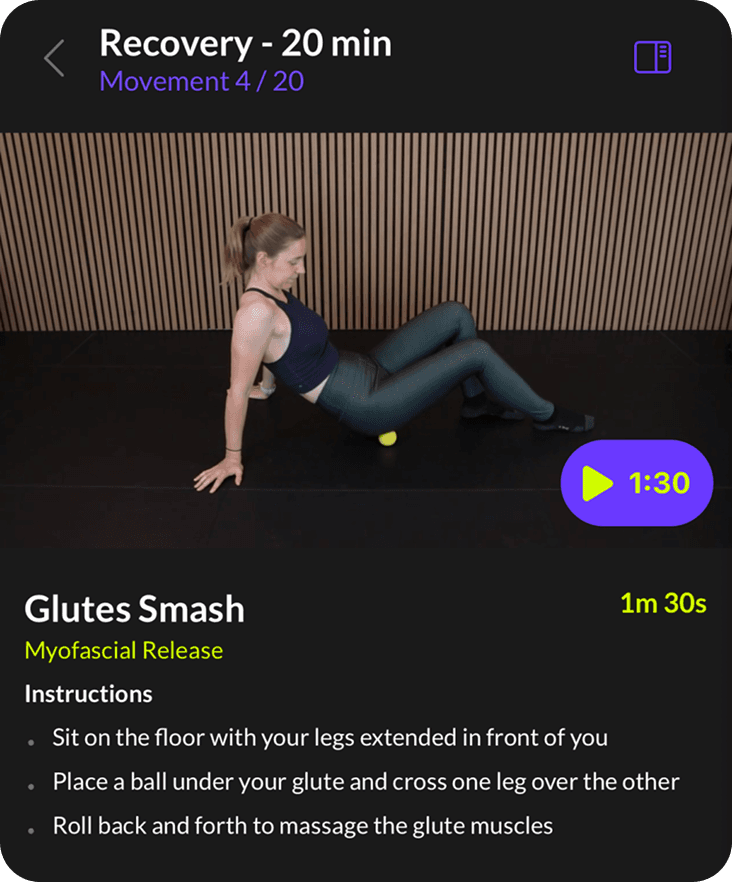
For specific areas, follow our protocols for foam rolling the quads and releasing the glutes with a lacrosse ball.
Plan your week around muscle groups
The best recovery tool in CrossFit is the order of your sessions. A simple rule: after a hard session for a muscle group, give it 48 hours before loading it hard again.
| If yesterday was... | Today, prefer... | Avoid... |
|---|---|---|
| Heavy squats, thrusters, wall balls | Upper body gymnastics, rowing, skill work | Lunges, box jumps, heavy pulls from the floor |
| Deadlifts, cleans, kettlebell swings | Pressing, monostructural conditioning | Heavy hinging, high-rep good mornings |
| Pull-ups, toes-to-bar, rope climbs | Squats, running, bike | Muscle-ups and high-rep kipping |
| Long engine WOD (running, row, bike) | Strength with long rest periods | Another long conditioning piece |
If your box programs the WOD for you, you can still adjust: scale the volume of the movements that hit your sore muscles, or use an open gym day to do your own recovery session. If pull-ups, toes-to-bar and rope climbs pile up and your elbows start to complain, forearm pain after pull-ups explains how to keep pulling while it settles.
The basics that matter most
Sleep. 7 to 9 hours a night. Sleep loss reduces strength, slows muscle repair and increases injury risk (Fullagar et al., 2015). If you train early in the morning, the time you go to bed matters more than any supplement.
Protein. Around 1.6 g per kg of body weight a day, spread over 3 to 4 meals, maximises muscle and strength gains from training (Morton et al., 2018). For an 80 kg athlete, that's about 130 g a day.
Carbohydrates. CrossFit runs mostly on glycogen. Cutting carbs while training five days a week is a common reason for flat performance and heavy legs.
Massage. It has the most consistent evidence for reducing soreness among recovery techniques (Dupuy et al., 2018). Foam rolling and lacrosse balls give you a home version every day.
Cold water. Fine before a competition or between competition days. Used after every strength session, it can reduce strength and muscle gains, so don't make it a daily habit.
Rest days and deloads
Recovery is a process across weeks, not just hours (Kellmann et al., 2018). Two tools stop fatigue from accumulating:
- Rest days. 1 to 2 a week. An active rest day, with a walk, easy bike and 20 minutes of mobility, often feels better than doing nothing.
- Deload weeks. Every 4 to 8 weeks, cut volume by about 40% and keep intensity moderate. Plan one after a competition or the CrossFit Open. Our guide on when to take a deload week and how to run it has a CrossFit example week. If a deload doesn't bring you back, see overtraining recovery, stage by stage.
Signs you need one sooner: lifts going down for over a week, a higher resting heart rate, poor sleep, joints that ache, or no motivation to go to the box.
In short
After each WOD: 5 minutes of cooldown, 10 minutes on the muscles you trained, a real meal. Each day: 7 to 9 hours of sleep and about 1.6 g/kg of protein. Each week: don't load the same muscle group hard two days in a row, and take 1 to 2 rest days. Every 4 to 8 weeks: a deload. For lower body days, also read how to recover from squats and, if your back complains after pulling, lower back pain after deadlifts.
Frequently asked questions
+How many rest days do you need in CrossFit?
Most athletes do well with 1 to 2 full rest days a week, often in a 3-on-1-off or 5-on-2-off pattern. What matters more is not hitting the same muscle group hard two days in a row.
+Is it OK to do CrossFit while sore?
Mild soreness is fine: warm up and train, often it fades during the session. If soreness changes how you move, pick a WOD that uses other muscle groups or scale the load and volume.
+What is the fastest way to recover after a WOD?
Cool down for 5 to 10 minutes, eat protein and carbohydrates within a few hours, sleep 7 to 9 hours, and use 10 minutes of targeted soft tissue and mobility work on the muscles you trained.
+Why am I so sore after CrossFit even after years of training?
Soreness comes from unfamiliar or high-volume eccentric work: high-rep lunges, box jumps, wall balls, kipping pull-ups or a new movement. Programmed variety means you regularly meet loads your muscles aren't used to.
+Should I deload in CrossFit?
Yes. A lighter week every 4 to 8 weeks, with less volume and intensity, lets accumulated fatigue drop and often leads to PRs the following week.
Get this routine built from your own training
Log your workouts and Rekup estimates the load on each muscle group, shows when each one is ready again, and builds a recovery routine for the muscles you actually trained, from more than 130 movements.
Try Rekup PRO free for 14 daysFree plan available. Cancel the trial anytime from the store.


This guide is educational and does not replace a diagnosis. If pain is severe, keeps getting worse or comes with the warning signs listed above, see a doctor or a physiotherapist.
Sources
- Dupuy O et al. An evidence-based approach for choosing post-exercise recovery techniques. Frontiers in Physiology, 2018.
- Gabbett TJ. The training-injury prevention paradox: should athletes be training smarter and harder? British Journal of Sports Medicine, 2016.
- Morton RW et al. A systematic review, meta-analysis and meta-regression of the effect of protein supplementation on resistance training-induced gains in muscle mass and strength. British Journal of Sports Medicine, 2018.
- Fullagar HH et al. Sleep and athletic performance. Sports Medicine, 2015.
- Wiewelhove T et al. A meta-analysis of the effects of foam rolling on performance and recovery. Frontiers in Physiology, 2019.
- Kellmann M et al. Recovery and performance in sport: consensus statement. International Journal of Sports Physiology and Performance, 2018.
- MedlinePlus. Rhabdomyolysis.