
Lacrosse Ball Glute and Piriformis Release: How to Do It
By the Rekup team · Published October 23, 2026 · 4 min read
To release your glutes with a lacrosse ball, sit or lean on the ball, find a tender spot in the buttock, hold it for 20 to 30 seconds while breathing slowly, then add small hip movements, for 60 to 90 seconds per spot. For the piriformis, cross the ankle over the opposite knee while sitting on the ball. Keep the pressure at 5 to 7 out of 10, and move the ball if you feel tingling or electric pain: that is a nerve, not a knot.
Why a ball instead of a roller
The glutes are a deep, layered area. A foam roller works well on the big glute max, but it can't reach the smaller muscles underneath and to the side: the piriformis (deep, from the sacrum to the top of the thigh bone) and the glute medius (on the side of the hip, just under the bony ridge of the pelvis). Those are the ones that feel tight after running, lunges, sled pushes or long hours sitting.
A lacrosse ball is small and firm, so it concentrates pressure where a roller spreads it. The trade-off: it's more intense, and easier to overdo.
A word on evidence: most studies are on foam rollers, not balls. They show small, consistent benefits on range of motion and perceived soreness (Wiewelhove et al., 2019; Konrad et al., 2022). There is no reason to think a ball works differently, but there is also no specific study proving it works better. Treat it as a precise tool, not a stronger medicine. For what rolling does and doesn't do to fascia, see how long myofascial release lasts.
Three spots, one routine
Total time on each spot follows the same logic as with a roller: benefits on range of motion appear from about 90 seconds per muscle (Hughes & Ramer, 2019), so two to three spots per side, done properly, beat ten rushed ones.
Too intense? Start against a wall
On the floor, your whole body weight is on the ball. If that is too much, especially on a sore day, do the same routine standing with the ball between your glute and a wall. You control the pressure by how much you lean. Once that feels easy, move to the floor.
What to do right after: mobility and activation
Pressure lowers tension for a while. Use that window to move through range and switch the muscles back on, otherwise the effect fades quickly:
- 90/90 hip switches: sitting with both knees bent at 90°, rotate both knees from one side to the other, 2 sets of 8.
- Glute bridge: 2 sets of 10 slow reps, squeezing at the top for two seconds.
- Side-lying clamshell with a band: 2 sets of 12 per side, for the glute medius.
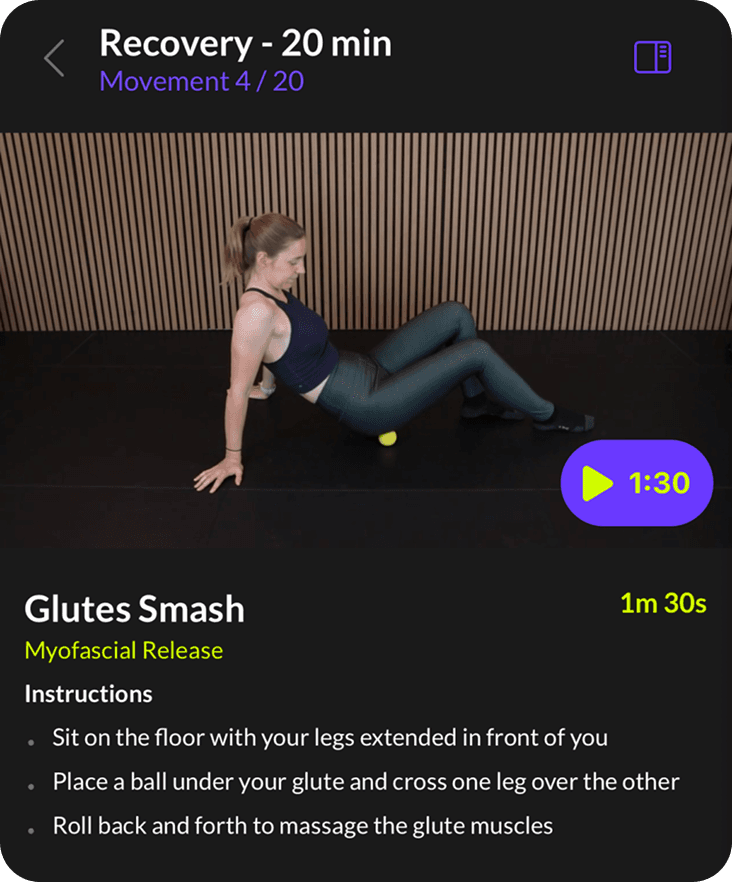
Release, mobility and activation are the three families of movements Rekup draws on to build its routines; the "glutes smash" you will find in the app is this kind of ball work.
When to use it
- After training, especially after running, lunges, sled work, heavy hip hinges or box step-ups: the full routine.
- On rest days if your hips feel stiff: the full routine, followed by the mobility drills.
- Before training, only briefly: 30 seconds per spot, then a normal warm-up. Long, intense pressure right before heavy lifts isn't necessary.
- After long hours sitting: two minutes against a wall and a few bridges do more than nothing.
Muscle tightness or a nerve?
The sciatic nerve runs right next to, and sometimes through, the piriformis. That is why buttock pain is not always muscular. Muscle tightness is a dull, local ache that a ball usually relieves. Nerve irritation behaves differently.
The short version
Use the ball on three spots, glute max, piriformis and glute medius, for 60 to 90 seconds each, holding tender points and adding small movements. Start against a wall if the floor is too intense, finish with mobility and a few bridges, and stay away from anything that tingles. For the front of the legs, see how to foam roll your quads.
Frequently asked questions
+How long should I keep a lacrosse ball on my glutes?
Spend 60 to 90 seconds per spot, with 20 to 30 seconds of stillness on the most tender point, then add small hip movements. Two or three spots per side is enough, so the whole routine takes about five minutes.
+How do I release my piriformis with a lacrosse ball?
Sit on the ball in the middle of the buttock, cross that ankle over the opposite knee to stretch the piriformis, and lean slightly toward the crossed leg. Hold on tender spots and slowly let the crossed knee drop and rise.
+Is it better to use a lacrosse ball or a foam roller for glutes?
A ball reaches the deep, small areas of the glutes, like the piriformis and glute medius, that a roller covers poorly. Start with the roller if the ball is too intense, then move to the ball against a wall before using it on the floor.
+Can a lacrosse ball help sciatica?
Not reliably, and pressing on an irritated nerve can make it worse. If you have pain running down the back of the leg, numbness or tingling, see a doctor or physiotherapist before using a ball on the area.
+Should a lacrosse ball on the glutes be painful?
It should feel intense but tolerable, around 5 to 7 out of 10. If you feel burning, electric or tingling sensations, you are on a nerve: move the ball a few centimetres.
Get this routine built from your own training
Log your workouts and Rekup estimates the load on each muscle group, shows when each one is ready again, and builds a recovery routine for the muscles you actually trained, from more than 130 movements.
Try Rekup PRO free for 14 daysFree plan available. Cancel the trial anytime from the store.


This guide is educational and does not replace a diagnosis. If pain is severe, keeps getting worse or comes with the warning signs listed above, see a doctor or a physiotherapist.
Sources
- Wiewelhove T et al. A meta-analysis of the effects of foam rolling on performance and recovery. Frontiers in Physiology, 2019.
- Hughes GA, Ramer LM. Duration of myofascial rolling for optimal recovery, range of motion, and performance. International Journal of Sports Physical Therapy, 2019.
- Konrad A et al. Foam rolling training effects on range of motion: a systematic review and meta-analysis. Sports Medicine, 2022.
- NHS. Sciatica.