
Hyrox Recovery: What to Do in the 7 Days After a Race
By the Rekup team · Published October 23, 2026 · 5 min read
After a Hyrox race, spend day 0 cooling down, eating and sleeping, use days 1 to 3 for walking, easy cycling and soft tissue work, and wait until around day 6 or 7 before intervals or heavy leg training. Soreness usually peaks on day two, mostly in the quads and glutes from the sandbag lunges and wall balls. Cold water is fine on race day, because after a race short-term recovery matters more than training adaptation.
What a Hyrox does to your body
A Hyrox race is 8 rounds of a 1 km run followed by a workout station: 1,000 m SkiErg, 50 m sled push, 50 m sled pull, 80 m burpee broad jumps, 1,000 m row, 200 m farmers carry, 100 m sandbag lunges and 100 wall balls (HYROX). That order matters for recovery: the most leg-destroying stations come last, when you are already tired.
| Muscle group | Where the load comes from | What to expect |
|---|---|---|
| Quads | Sled push, sandbag lunges, wall balls, 8 km of running | The most sore, peaking on day 2 |
| Glutes and hamstrings | Lunges, burpee broad jumps, sled pull, running | Very sore, worse when sitting down and standing up |
| Calves | Running, sled push | Tight and sore, especially for heel strikers on hard floors |
| Shoulders and triceps | Wall balls, SkiErg, burpees | Moderate soreness |
| Lats and upper back | SkiErg, row, sled pull | Moderate, often underestimated |
| Forearms and grip | Farmers carry, sled pull rope | Short-lived fatigue, sometimes sore hands |
Grip fatigue from the carries and the sled rope usually fades within a day or two; if the pain sits on a bony point at the elbow instead, see forearm pain after pull-ups, which covers the same tendons.
The sandbag lunges are the station that leaves the deepest marks: 100 metres of loaded lunges is a big dose of eccentric work for the quads and glutes, done under fatigue, which is exactly what causes delayed soreness (Cheung et al., 2003).
Day-by-day recovery plan
Cold water, compression and massage: what's worth it
Cold water. It reduces soreness and the feeling of fatigue in the short term. Used after every training session, it blunts strength and muscle gains (Roberts et al., 2015), which is why it shouldn't be a daily habit. After a race, that trade-off disappears: you want to feel better fast, and there is no training adaptation to protect. Race day and the day after are the right time for it.
Compression. Compression garments have a modest positive effect on soreness and on the recovery of strength (Brown et al., 2017). They are most useful on the trip home, when you sit for hours.
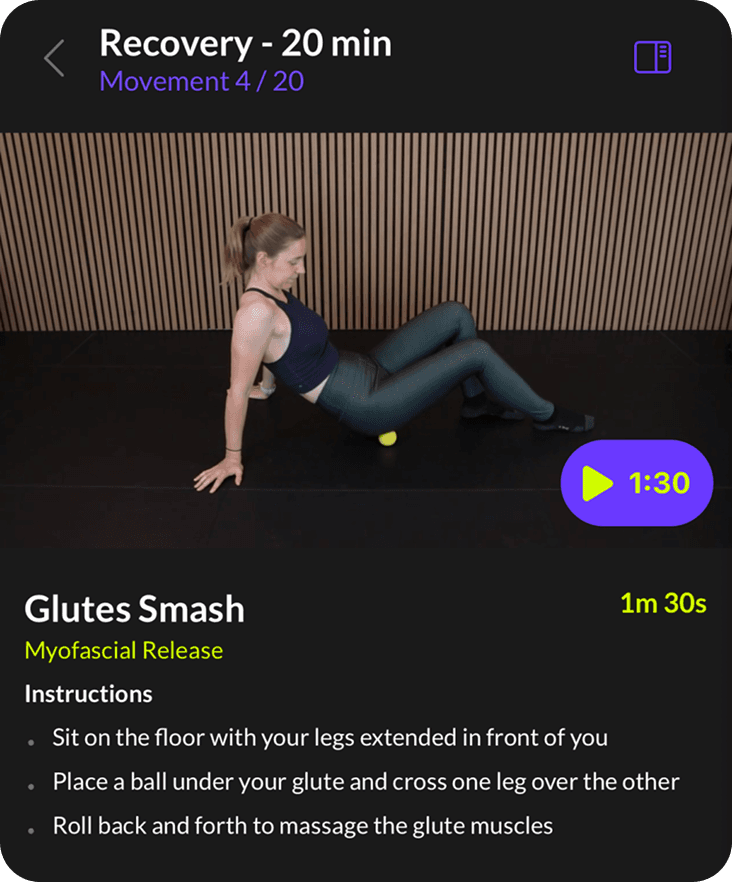
Massage and rolling. Massage has the most consistent effect on soreness and perceived fatigue among recovery techniques (Dupuy et al., 2018). Foam rolling gives a smaller version of the same benefit, at home, every day. Our guides on foam rolling quads and releasing the glutes with a lacrosse ball cover the two areas that hurt most after a race.
Signs you need more time
Soreness fading doesn't always mean you are recovered. Give yourself a few more easy days if you notice:
- a resting heart rate noticeably above your usual in the morning;
- poor sleep despite feeling tired;
- legs that feel heavy and flat on easy runs;
- irritability, low motivation or a drop in appetite.
These signs are common after a first race or a big personal best, and they are a better guide to your next hard session than the calendar. If they keep coming back during a training block, not just after races, it is time for a lighter week of training.
Getting ready for the next race
Many athletes do several Hyrox races a season. Recovery from one race is part of preparing the next: the athletes who get least sore are those who regularly train lunges, wall balls and sled work in their programme, because muscles adapt to the eccentric work they meet often. If your soreness after a race is extreme, it is usually a sign that the station work in training was too far from race volume. The same logic applies to strength days: our guide on recovering from squats explains how to build leg volume without paying for it all week.
In short
Day 0: walk, eat, sleep, cold water if you like. Days 1 to 3: easy movement, rolling or massage, mobility. Days 4 to 5: a first easy run. From day 6 or 7: back to hard training once your legs, sleep and heart rate say so. And next time, train the stations at race volume, so the race hurts less. For soreness in general, read how to get rid of DOMS.
Frequently asked questions
+How long does it take to recover from a Hyrox race?
Most athletes feel the worst soreness on day two and are back to easy training by day three or four. Plan about a week before hard intervals or heavy leg work, longer after your first race or a big personal best.
+Why are my legs so sore after Hyrox?
The sandbag lunges, wall balls and sled push come after kilometres of running, and the lunges in particular are highly eccentric for the quads and glutes. Eccentric work under fatigue is the main driver of delayed soreness.
+Should I take an ice bath after Hyrox?
On race day, yes if you like it: cold water reduces soreness in the short term, and long-term adaptation doesn't matter after a race. Don't make it a habit after regular training sessions, where it can blunt strength gains.
+When can I run again after Hyrox?
An easy 20 to 30 minute run is usually fine from day three or four if soreness no longer changes your stride. Wait until your legs feel normal, often around day six or seven, before intervals.
+Is Hyrox doubles or relay recovery different?
Yes. You share the station work, so total muscle damage is usually lower, but the running pace is often faster. Expect a similar pattern with less soreness, and follow the same plan with a shorter timeline.
Get this routine built from your own training
Log your workouts and Rekup estimates the load on each muscle group, shows when each one is ready again, and builds a recovery routine for the muscles you actually trained, from more than 130 movements.
Try Rekup PRO free for 14 daysFree plan available. Cancel the trial anytime from the store.


This guide is educational and does not replace a diagnosis. If pain is severe, keeps getting worse or comes with the warning signs listed above, see a doctor or a physiotherapist.
Sources
- HYROX. The Fitness Race: format and stations.
- Dupuy O et al. An evidence-based approach for choosing post-exercise recovery techniques. Frontiers in Physiology, 2018.
- Roberts LA et al. Post-exercise cold water immersion attenuates acute anabolic signalling and long-term adaptations in muscle to strength training. Journal of Physiology, 2015.
- Brown F et al. Compression garments and recovery from exercise: a meta-analysis. Sports Medicine, 2017.
- Fullagar HH et al. Sleep and athletic performance. Sports Medicine, 2015.
- Cheung K, Hume P, Maxwell L. Delayed onset muscle soreness: treatment strategies and performance factors. Sports Medicine, 2003.
- MedlinePlus. Rhabdomyolysis.