
How Long Does Overtraining Last? Recovery Timeline by Stage
By the Rekup team · Published November 18, 2026 · 8 min read
Functional overreaching, the mild form, clears in a few days to two weeks of lighter training. Non-functional overreaching takes weeks to a few months. True overtraining syndrome lasts months, sometimes longer, and needs a doctor to rule out other causes. Which one you have depends on how long your performance has been dropping and whether a week of rest fixes it.
Overreaching vs overtraining: three stages, three timelines
"Overtraining" is used loosely to mean any training fatigue that won't go away. Sports scientists split it into three stages, defined by the joint consensus statement of the European College of Sport Science and the American College of Sports Medicine (Meeusen et al., 2013). The difference between them is not how tired you feel, but how long it takes for performance to come back.
| Stage | What happens | Typical recovery | Outcome |
|---|---|---|---|
| Functional overreaching (FOR) | A hard block leaves performance down for a short time | Days to about 2 weeks | Performance rebounds above where it started. This is normal training. |
| Non-functional overreaching (NFOR) | Heavy load without enough recovery; performance stays down, often with poor sleep or low mood | Weeks to months | Full recovery, but no gain from the block |
| Overtraining syndrome (OTS) | Prolonged maladaptation affecting several body systems | Months, sometimes longer | Recovery is slow and requires ruling out other diseases |
Kreher and Schwartz, in a practical guide for physicians, describe overtraining syndrome as extreme non-functional overreaching with a performance decline lasting more than two months and more severe symptoms (Kreher & Schwartz, 2012). Both papers stress the same point: there is no clean line between NFOR and OTS, and the label is often only given in hindsight, once you know how long recovery took.
The good news is that most people who think they are "overtrained" are in the first or second stage. Real overtraining syndrome is rare in recreational athletes.
Which stage are you in? A self-check
Answer these honestly. They are the questions that separate the three stages in practice.
How long functional overreaching lasts (days to 2 weeks)
Functional overreaching is the state most training programs aim for on purpose: a few weeks slightly above what you can fully absorb, followed by recovery. Performance dips for a few days to around two weeks, then comes back higher (Meeusen et al., 2013).
The fix is a deload: same movements, about half the sets, well short of failure, for 5 to 7 days. Our deload week guide has the full protocol and examples for lifting, CrossFit, Hyrox and running. The lever behind it is well studied: in a meta-analysis of tapering studies, cutting training volume by 41 to 60% while keeping intensity gave the best performance gains (Bosquet et al., 2007).
If you deload and feel better by day 5 or 6, you were here. Go back to training.
How long non-functional overreaching lasts (weeks to months)
Non-functional overreaching happens when the hard block goes on too long, or when other stress piles on top. Performance drops and stays down for weeks to months, often with poor sleep, heavy legs, irritability and a lack of drive. You recover fully, but the training block that caused it brought you nothing (Meeusen et al., 2013).
A single deload week is not enough here. What tends to work is two to four weeks of clearly reduced training:
- Cut intensity first, not just volume. No max lifts, no all-out metcons, no intervals. Easy aerobic work and technique sessions only.
- Keep sessions short. 30 to 45 minutes, and stop while you still feel good.
- Move every day, lightly. Walks, easy cycling, swimming and mobility work keep you active without adding load.
- Fix the inputs. Sleep and food are the recovery. Our guide on sleep and muscle recovery explains why sleep loss directly slows muscle repair.
- Remove other stressors where you can. A diet, a new training program or a race should wait.
Then return gradually (see the plan below). If you are not clearly improving after three or four weeks of this, stop managing it alone and see a doctor.
How long overtraining syndrome lasts (months)
Overtraining syndrome is a prolonged state where the body stops adapting to training. Symptoms go beyond fatigue: persistent low mood, disrupted sleep, frequent infections, loss of appetite, hormonal changes, and performance that keeps falling even after rest (Kreher & Schwartz, 2012). Recovery is measured in months, and in some cases athletes take longer to get back to their previous level.
There is no test that confirms it. Doctors diagnose overtraining syndrome by ruling out everything else that looks like it, including anaemia, thyroid disease, infections (such as glandular fever) and eating too little for the training load (Meeusen et al., 2013). The treatment is rest, then a very gradual return guided by symptoms.
One cause deserves its own mention. Low energy availability, training hard while eating too little, produces many of the same symptoms: fatigue, worse performance, frequent illness, mood changes and, in women, menstrual disturbances. The International Olympic Committee calls the result Relative Energy Deficiency in Sport (Mountjoy et al., 2023). It is common in athletes who are cutting weight or trying to "eat clean" while training five or six days a week, and it will not resolve with rest alone.
Coming back: a 4-week return plan after overreaching
There is no validated return-to-training protocol for overreaching; the consensus recommendation is reduced training and a gradual, symptom-guided return. The plan below is our example of what that looks like for someone recovering from non-functional overreaching who trained 4 to 6 times a week. Adapt it to your sport, and use it after a doctor has cleared you if you suspected overtraining syndrome.
| Week | Volume (vs your normal) | Intensity | What it looks like |
|---|---|---|---|
| 1 | About 30 to 40% | Easy only, conversational effort | 3 to 4 short sessions: easy aerobic work, technique with light loads, mobility |
| 2 | About 50% | Easy, plus light strength at 3 to 4 reps in reserve | 4 sessions, no conditioning above 6/10 effort |
| 3 | About 60 to 70% | One moderate session | Strength at normal weights but half the sets; one short, controlled conditioning piece |
| 4 | About 80% | Normal intensity, short efforts | Back to your usual structure without max attempts or long chippers |
The rule that matters more than the table: only move to the next week if you slept well, woke up wanting to train, and the previous week's sessions felt easier as it went on. If symptoms come back, drop back a week. Coming back too fast is the most common reason overreaching drags on for months.
For CrossFit and Hyrox athletes, the trap is the conditioning. A strength session at half volume followed by an all-out metcon or a full compromised-run session is not a reduced week. Keep conditioning at 6 to 7 out of 10 until week 4. Our guides on recovering from CrossFit and Hyrox recovery cover sport-specific recovery once you are back to full training.
What helps you recover faster, and what doesn't
What has the best support is unglamorous: less training load, more sleep, and enough food, especially carbohydrates and protein while you are still training. Nothing replaces those three.
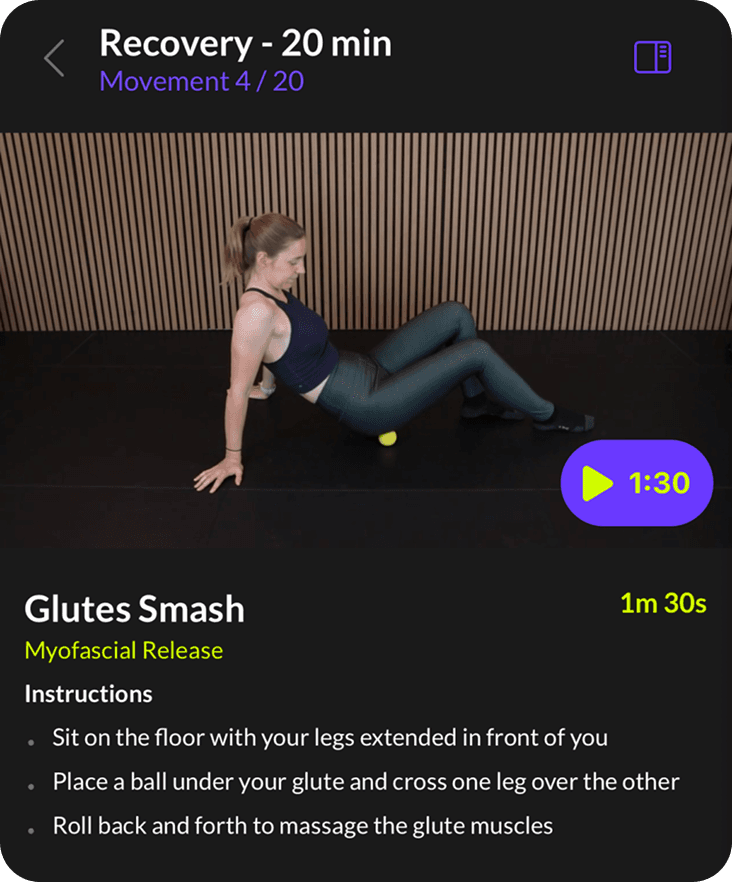
Soft-tissue work, mobility and easy movement help you feel better and keep moving while load is reduced; our guide on what myofascial release actually does explains why its effects are mostly short-term. They are useful additions, not a fix for whole-body fatigue. The same goes for massage guns, compression and cold water: they can ease soreness, but they cannot make up for a training load you cannot absorb. If day-to-day soreness is your main issue rather than weeks of fatigue, start with our DOMS protocol and the methods ranked in how to recover faster between workouts.
How to stop it from happening again
Overreaching rarely comes from one bad week. It comes from several weeks where load went up and recovery didn't. Three habits prevent most cases:
- Plan lighter weeks. A deload every 4 to 8 weeks, and after every competition.
- Track load and how you feel, not just what you lift. Note sleep quality, soreness and motivation. When two or three of them get worse for a week, back off before performance drops.
- Count life as load. Exams, work stress, travel and dieting all eat into the same recovery budget as training.
The bottom line
If a week of lighter training fixes it, it was functional overreaching, and it lasted days. If it doesn't, expect weeks: reduce intensity as well as volume for two to four weeks, sleep and eat properly, and come back gradually. If performance has been falling for more than a couple of months, or fatigue comes with whole-body symptoms, see a doctor: overtraining syndrome lasts months, and several other conditions look the same.
Frequently asked questions
+Can you recover from overtraining in a week?
From functional overreaching, yes: a week of reduced training is often enough, and performance usually comes back above where it was. If you still feel flat after a full week of easy training and good sleep, you are probably in non-functional overreaching, which takes weeks rather than days.
+Should I stop training completely if I am overtrained?
For overreaching, no: reduce volume and intensity and keep moving. For suspected overtraining syndrome, the consensus treatment is rest, then a slow, symptom-guided return, ideally with a doctor ruling out other causes first. Pushing through is the one option that reliably makes it last longer.
+Is there a test for overtraining?
No single blood test or wearable metric can diagnose overtraining syndrome. Doctors diagnose it by excluding other causes, such as anaemia, thyroid problems, infections or low energy intake, and by checking that performance has dropped despite rest. A falling HRV or rising resting heart rate is a useful warning sign, not a diagnosis.
+How do I know if it's overtraining or just being tired?
Normal tiredness after a hard week passes in a few days of easier training. Overreaching or overtraining shows as performance that keeps dropping at the same effort, combined with symptoms such as poor sleep, low mood or frequent colds, that do not lift after a week of rest.
+Can not eating enough cause overtraining symptoms?
Yes. Low energy availability, eating too little for the training you do, causes many of the same symptoms: fatigue, poor performance, mood changes, frequent illness and menstrual disturbances. The IOC calls this Relative Energy Deficiency in Sport (REDs). It is common in athletes who train hard while trying to lose weight.
Get this routine built from your own training
Log your workouts and Rekup estimates the load on each muscle group, shows when each one is ready again, and builds a recovery routine for the muscles you actually trained, from more than 130 movements.
Try Rekup PRO free for 14 daysFree plan available. Cancel the trial anytime from the store.


This guide is educational and does not replace a diagnosis. If pain is severe, keeps getting worse or comes with the warning signs listed above, see a doctor or a physiotherapist.
Sources
- Meeusen R et al. Prevention, diagnosis, and treatment of the overtraining syndrome: joint consensus statement of the European College of Sport Science and the American College of Sports Medicine. Medicine & Science in Sports & Exercise, 2013.
- Kreher JB, Schwartz JB. Overtraining syndrome: a practical guide. Sports Health, 2012.
- Mountjoy M et al. 2023 International Olympic Committee's (IOC) consensus statement on Relative Energy Deficiency in Sport (REDs). British Journal of Sports Medicine, 2023.
- Bosquet L, Montpetit J, Arvisais D, Mujika I. Effects of tapering on performance: a meta-analysis. Medicine & Science in Sports & Exercise, 2007.