
Should You Stretch After a Workout? What the Research Says
By the Rekup team · Published October 24, 2026 · 6 min read
Stretching after a workout is not bad for you, but it does not do what most people expect. Research shows that post-workout stretching does not reduce soreness, speed up the recovery of strength, or prevent injuries. What it does well is improve flexibility over weeks, and help you wind down. If you train hard and want to recover faster, light movement, self-massage, sleep and food do more than any stretch.
What stretching after a workout does, and doesn't do
Stretching after training has been sold as a recovery method for decades. The studies do not support most of those claims.
| Claim | What the research says |
|---|---|
| Reduces muscle soreness (DOMS) | Effect too small to notice: a few points on a 100-point scale (Herbert et al., Cochrane 2011) |
| Speeds up strength and range of motion recovery | No benefit compared with passive rest or easy cycling, at any time point (Afonso et al., 2021) |
| Prevents injuries | No protective effect in pooled trials; strength training did far better (Lauersen et al., 2014) |
| Improves flexibility over time | Yes: regular stretching for at least two weeks increases range of motion (Konrad et al., 2024) |
| Helps you calm down after a hard session | Plausible and harmless, but it is a feeling, not a recovery effect |
The 2021 meta-analysis by Afonso and colleagues is the most direct answer to the question. It pooled randomized trials comparing stretching after exercise with passive recovery or other light activities, and found no extra benefit on soreness, strength or range of motion, in the hour after training or in the following days. The authors noted this contradicts many current recommendations.
So the honest answer to "should you stretch after a workout?" is: only if you want to gain flexibility or you enjoy it. Don't count on it to make tomorrow's session feel better.
Why stretching doesn't help muscles recover
Delayed onset muscle soreness comes from micro-damage to muscle fibres, mostly after eccentric work (the lowering phase of a squat, lunges, downhill running), followed by inflammation and a temporary sensitisation of nerves. Pulling on a muscle does not repair fibres or clear that inflammation faster.
What does help is pressure and blood flow. In the evidence on recovery methods, massage and foam rolling reduce perceived soreness more than stretching does, and foam rolling after training gives a small but consistent reduction in muscle pain (Wiewelhove et al., 2019). Light cardio helps you feel less stiff. Sleep and protein support the repair itself. We rank these methods in detail in our guide on how to recover faster between workouts.
When stretching after training is worth it
Stretching earns its place when the goal is range of motion, not recovery.
- You lack a position your sport needs. A front rack, an overhead squat, a deep squat for Olympic lifts, a long stride. Regular stretching increases range of motion within a few weeks, and static stretching produces larger gains than dynamic stretching (Konrad et al., 2024).
- You sit most of the day. Stiff hip flexors and hamstrings are a common pattern. Our guides on tight hip flexors and tight hamstrings combine stretching with the strength work that keeps the gains.
- You want a cooldown habit. Five minutes of breathing and gentle stretching can mark the end of a session. That is a perfectly good reason, as long as you know what it is for.
After a workout is actually a good moment for flexibility work: the muscles are warm, you are already in the gym, and pre-workout static stretching is what can cost you performance (see below).
How to stretch after a workout if you do it
The American College of Sports Medicine recommends flexibility exercises at least two to three days a week, holding each stretch for 10 to 30 seconds and repeating it two to four times, to a point of mild tension without pain (Garber et al., 2011).
When not to stretch after training
- Right after very heavy eccentric work (high-volume lunges, Nordic curls, a first session back after a break). The muscle is already damaged; deep, forceful stretching adds strain without helping it recover. Light movement and rolling are a better choice that day.
- On an acute injury. A strain, a sudden sharp pain during a rep, swelling or bruising: don't stretch it. See a physiotherapist.
- Before a heavy or explosive session. Long static holds before training can slightly reduce strength and power, mainly when they exceed about 60 seconds per muscle (Behm et al., 2016). Warm up dynamically instead and save static stretching for after.
What to do instead to recover after training
If your goal is to feel ready for the next session, spend those post-workout minutes on what has evidence behind it:
- 5 to 10 minutes of easy cardio: bike, row or walk at a conversational pace.
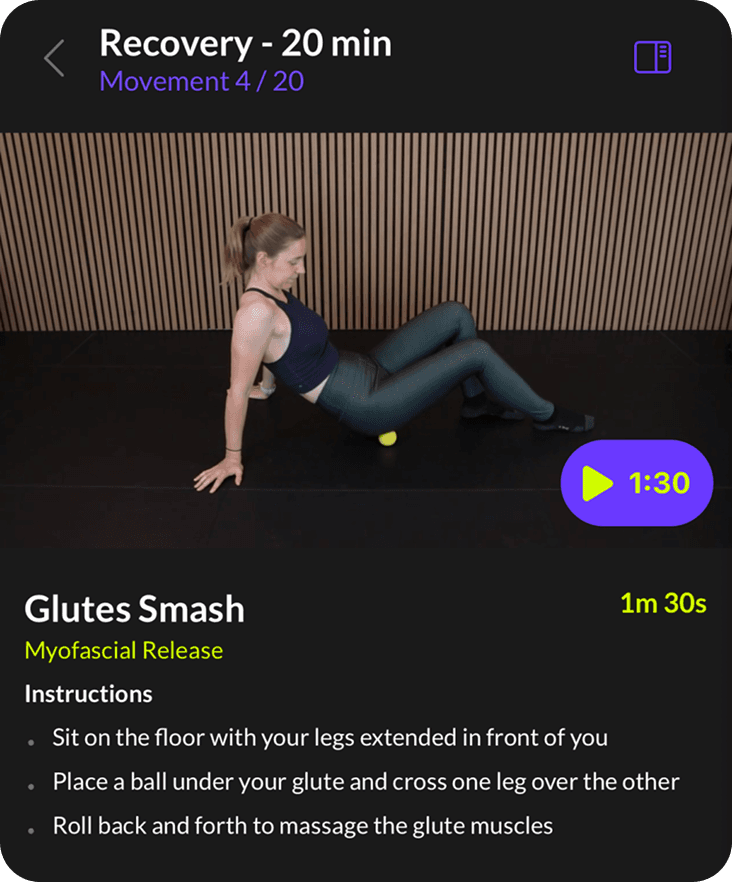
- Self-massage on the muscles you loaded: 60 to 120 seconds per area with a foam roller or a ball. Our guides on foam rolling your quads and releasing the glutes with a lacrosse ball go through the technique.
- A meal with enough protein in the following hours.
- A full night of sleep, the recovery method nothing else replaces.
If you are already sore, our guide on how to get rid of DOMS has a day-by-day protocol, and our guide on recovery time by muscle group tells you how many days to leave before training the same muscle hard again.
The bottom line
Stretch after training if you want more range of motion or a calm end to your session, a few minutes a few times a week, without forcing. Don't stretch to recover: it doesn't shorten soreness or bring strength back sooner, and it doesn't prevent injuries. For recovery, move lightly, roll the muscles you worked, eat and sleep.
Frequently asked questions
+Is it bad to stretch after a workout?
No. Gentle static stretching after training is not harmful for most people, it just does not speed up recovery. The only thing to avoid is forcing deep, painful stretches on a muscle you have just exhausted with heavy eccentric work.
+Does stretching after a workout prevent soreness?
Barely. A Cochrane review found that stretching before, after or around exercise reduces soreness by a few points on a 100-point scale, which nobody would notice. A 2021 meta-analysis found no benefit of post-exercise stretching on soreness, strength or range of motion recovery.
+Does stretching prevent injuries?
Not in the way most people think. In a large meta-analysis of injury-prevention trials, stretching showed no protective effect, while strength training reduced sports injuries to less than a third. Stretch for mobility, build strength for resilience.
+How long should you hold a stretch?
For flexibility, holding each stretch for 10 to 30 seconds and repeating it two to four times is the range most guidelines recommend. Long-term range of motion gains come from stretching regularly over weeks, not from long holds in one session.
+Is it better to stretch before or after training?
Before training, a dynamic warm-up does more than long static holds, which can slightly reduce strength and power if they exceed about 60 seconds per muscle. After training, or in a separate session, is the best time for static stretching aimed at flexibility.
Get this routine built from your own training
Log your workouts and Rekup estimates the load on each muscle group, shows when each one is ready again, and builds a recovery routine for the muscles you actually trained, from more than 130 movements.
Try Rekup PRO free for 14 daysFree plan available. Cancel the trial anytime from the store.


This guide is educational and does not replace a diagnosis. If pain is severe, keeps getting worse or comes with the warning signs listed above, see a doctor or a physiotherapist.
Sources
- Afonso J et al. The effectiveness of post-exercise stretching in short-term and delayed recovery of strength, range of motion and delayed onset muscle soreness: a systematic review and meta-analysis of randomized controlled trials. Frontiers in Physiology, 2021.
- Herbert RD, de Noronha M, Kamper SJ. Stretching to prevent or reduce muscle soreness after exercise. Cochrane Database of Systematic Reviews, 2011.
- Lauersen JB, Bertelsen DM, Andersen LB. The effectiveness of exercise interventions to prevent sports injuries: a systematic review and meta-analysis of randomised controlled trials. British Journal of Sports Medicine, 2014.
- Konrad A et al. Chronic effects of stretching on range of motion with consideration of potential moderating variables: a systematic review with meta-analysis. Journal of Sport and Health Science, 2024.
- Behm DG et al. Acute effects of muscle stretching on physical performance, range of motion, and injury incidence in healthy active individuals: a systematic review. Applied Physiology, Nutrition, and Metabolism, 2016.
- Garber CE et al. American College of Sports Medicine position stand: quantity and quality of exercise for developing and maintaining fitness. Medicine & Science in Sports & Exercise, 2011.
- Wiewelhove T et al. A meta-analysis of the effects of foam rolling on performance and recovery. Frontiers in Physiology, 2019.