
How to Release Tight Hip Flexors: 6 Moves That Work
By the Rekup team · Published October 23, 2026 · 4 min read
To release tight hip flexors, spend 60 to 90 seconds on soft tissue work at the front of the hip, then hold a half-kneeling hip flexor stretch with your glute squeezed for 30 to 60 seconds per side, and finish with glute activation. Done 4 to 6 times a week, this improves hip extension within a few weeks (Behm et al., 2016; Wilke et al., 2020). If you sit for long hours, run or squat a lot, the hip flexors rarely just need stretching: they also need the glutes to take over their share of the work.
Why your hip flexors feel tight
The hip flexors are the muscles that lift your thigh towards your chest: mainly the iliopsoas (psoas and iliacus), the rectus femoris (one of the quads), the tensor fasciae latae and the sartorius. They tighten for three common reasons:
- Sitting. Hours with the hip bent keep the hip flexors in a shortened position.
- Running and cycling. Every stride or pedal stroke uses them, thousands of times.
- Training volume. Sit-ups, toes-to-bar, high knees, sprints, lunges and squats all load them.
Often, the feeling of tightness is protective tension rather than a short muscle: when the glutes and deep abdominal muscles don't stabilise the pelvis well, the hip flexors take over. That's why stretching alone often brings relief for an hour and nothing more.
Quick test: are your hip flexors tight?
Lie on your back at the edge of a bed or bench, pull one knee to your chest, and let the other leg hang off the edge (the Thomas test). If the back of the hanging thigh lifts above the bench, or your knee straightens instead of staying bent at about 90°, your hip flexors limit hip extension on that side. Compare both sides.
The 10-minute hip flexor release routine
Foam rolling improves range of motion in the short term, with no negative effect on performance (Wilke et al., 2020; Wiewelhove et al., 2019). Stretching improves range of motion too; for longer static holds, keep them away from explosive training or do them after (Behm et al., 2016).
Common mistakes
- Arching the lower back in the stretch. If you feel it in your back instead of the front of the hip, you're extending the spine, not the hip. Tuck the pelvis and squeeze the glute.
- Pushing deep into the belly. You don't need to dig into the abdomen to reach the psoas. Work around the front of the hip and upper thigh instead.
- Only stretching. Without glute and core work, the tension comes back quickly.
- Holding long stretches right before sprints or heavy lifts. Use dynamic mobility before training.
Keep them from tightening again
- Break up sitting: stand up every 45 to 60 minutes and do 5 walking lunges or a short stretch.
- Strengthen the glutes: hip thrusts, bridges, split squats, 2 to 3 times a week.
- Train the full range: deep lunges and split squats load the hip flexors in a lengthened position.
- Balance volume: if your week includes lots of sit-ups, toes-to-bar or running, add hip flexor work after those sessions.
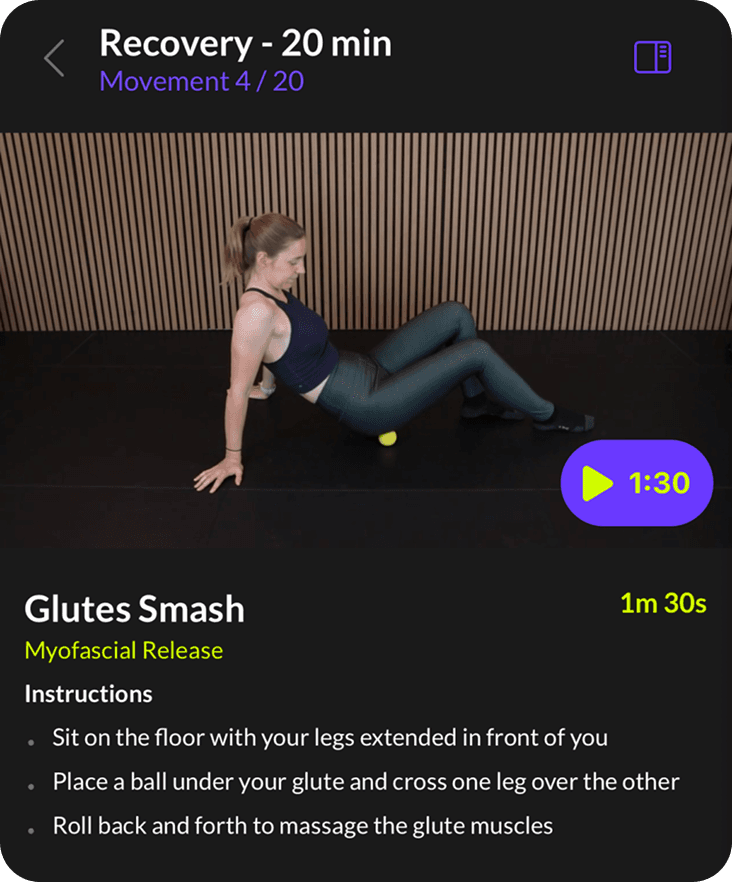
For the other side of the hip, see our guide on releasing the glutes and piriformis with a lacrosse ball. If your quads feel tight too, follow how to foam roll your quads.
In short
Release the front of the hip with a roller or ball, stretch in a half-kneeling position with the pelvis tucked and the glute squeezed, then activate the glutes and core. 10 minutes, 4 to 6 times a week. Break up long periods of sitting and strengthen the glutes so the tension doesn't come back.
Frequently asked questions
+How long does it take to loosen tight hip flexors?
You'll usually feel a difference after a single 10-minute session. Lasting change in range of motion takes regular work, 4 to 6 times a week for several weeks, plus strengthening the glutes.
+Should I massage my psoas directly?
Deep pressure into the abdomen to reach the psoas isn't necessary and can be uncomfortable or risky near organs and blood vessels. Work on the front of the hip and upper thigh instead, and use stretches and activation.
+Do tight hip flexors cause lower back pain?
They can contribute, by pulling the pelvis forward and increasing the arch of the lower back, especially when standing or running. They're rarely the only cause.
+Should I stretch my hip flexors before running?
Use dynamic moves before a run, like leg swings and walking lunges. Keep longer static holds for after training or a separate session: holds over 60 seconds right before training can slightly reduce power.
+Why are my hip flexors tight even though I stretch?
Often because they feel tight rather than being short: they are working hard to stabilise the pelvis because the glutes and core are not doing enough. Add glute activation and core work, not only stretching.
Get this routine built from your own training
Log your workouts and Rekup estimates the load on each muscle group, shows when each one is ready again, and builds a recovery routine for the muscles you actually trained, from more than 130 movements.
Try Rekup PRO free for 14 daysFree plan available. Cancel the trial anytime from the store.


This guide is educational and does not replace a diagnosis. If pain is severe, keeps getting worse or comes with the warning signs listed above, see a doctor or a physiotherapist.
Sources
- Behm DG et al. Acute effects of muscle stretching on physical performance, range of motion, and injury incidence in healthy active individuals: a systematic review. Applied Physiology, Nutrition, and Metabolism, 2016.
- Wilke J et al. Acute effects of foam rolling on range of motion in healthy adults: a systematic review with multilevel meta-analysis. Sports Medicine, 2020.
- Wiewelhove T et al. A meta-analysis of the effects of foam rolling on performance and recovery. Frontiers in Physiology, 2019.