
Best Recovery Apps 2026: Track Training and Muscle Recovery
By the Rekup team · Published October 23, 2026 · 6 min read
The best apps to boost recovery in 2026 are Rekup for muscle-level recovery (which muscles are fatigued and what to do about it), Whoop and Oura for sleep and heart rate variability tracking, Garmin if you already own a Garmin watch, and Athlytic or Bevel for a Whoop-style score on an Apple Watch. They answer different questions: a wearable tells you how recovered your body is overall; Rekup tells you which muscles are ready and gives you a routine for those that aren't. The most complete setup is one of each.
Disclosure: Rekup is our app. We've described each app as fairly as we can, including what Rekup doesn't do. Prices change often, so check the store before you subscribe.
Quick comparison
| App | Best for | What it measures | Recovery guidance | Needs a wearable |
|---|---|---|---|---|
| Rekup | Muscle-level recovery for CrossFit, Hyrox, lifting and running | Accumulated load per muscle group, from logged workouts and intensity | Muscle Readiness score + personalized routines (release, mobility, activation, blood flow) from 130+ movements | No |
| Whoop | 24/7 sleep, strain and HRV tracking | HRV, resting heart rate, sleep, strain | Daily recovery score, sleep and strain coaching | Yes, Whoop strap (included in the membership) |
| Oura | Sleep-focused recovery, discreet ring | HRV, temperature, sleep, activity | Readiness score, sleep insights | Yes, Oura Ring |
| Garmin Connect | Garmin watch owners, endurance athletes | HRV status, sleep, training load | Training Readiness, Body Battery, recovery time | Yes, compatible Garmin watch |
| Athlytic | Apple Watch users who want a simple score | HRV and resting heart rate from Apple Health | Recovery, exertion and sleep scores | Yes, Apple Watch |
| Bevel | Apple Watch users who want an all-in-one health app | Apple Health and other wearables | Recovery, sleep, strain, nutrition, AI coaching | Yes |
Two kinds of recovery apps
Recovery has several layers (Kellmann et al., 2018), and apps measure different ones:
- Systemic recovery: how your nervous system, sleep and general fatigue are doing. This is what heart rate variability and resting heart rate reflect (Plews et al., 2013), and what Whoop, Oura, Garmin, Athlytic and Bevel track.
- Local, muscle-level recovery: whether your quads are still loaded from Tuesday's squats while your back and shoulders are fresh. A good HRV doesn't tell you that. This is what Rekup models.
A green recovery score and sore, overloaded quads can coexist. That's when athletes get hurt: the body says "go", the legs aren't ready. Using both kinds of information is the most reliable way to decide what to train.
1. Rekup: best for muscle-specific recovery
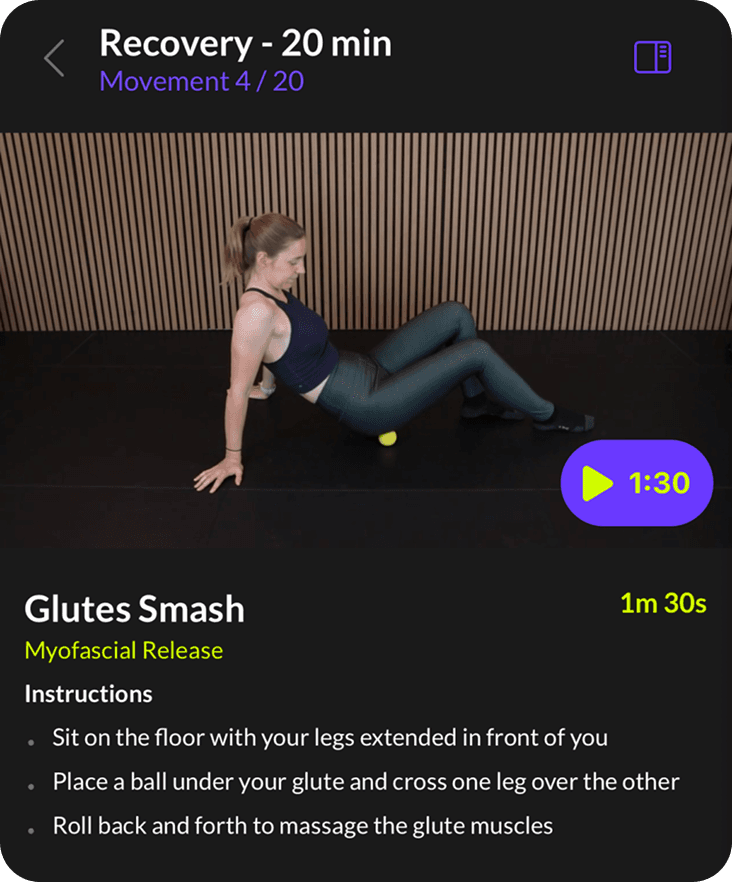
What it does. You log your workouts manually, or with an AI scan of a whiteboard photo or text. Rekup estimates the accumulated load on each muscle group based on the movements, volume and intensity, shows it on a body map, and gives you a Muscle Readiness score with a recommendation: push, train with care, or recover. Then it generates recovery routines targeted at the muscles you actually trained, built from more than 130 movements: myofascial release, mobility, muscle activation and blood-flow work, with a timer and instructions for each step.
Why it boosts recovery. It turns recovery into actions. Instead of a number, you get a 10 to 15-minute routine for today's fatigued muscles, and a clear signal for which muscle groups to avoid loading. That combination of planning load and targeted soft tissue work is what the evidence supports (Gabbett, 2016; Dupuy et al., 2018).
Limits. Rekup doesn't measure sleep or heart rate variability: its model is built on your training. Logging workouts takes a few seconds per session.
Best for: CrossFit, Hyrox, weightlifting and running athletes who train often and want to know which muscles need recovery.
2. Whoop: best for 24/7 recovery tracking
What it does. A screenless strap worn day and night tracks heart rate variability, resting heart rate, sleep and daily strain. Each morning you get a recovery score, along with sleep and strain recommendations. Higher tiers add features like stress monitoring and health metrics.
Strengths. Very good at what it measures: sleep and HRV trends, especially if you wear it consistently. The habit of checking your recovery each morning changes behaviour, mainly around sleep.
Limits. The recovery score is global. It doesn't know which muscles you trained or how sore they are, and it gives little guidance on what recovery work to do. It requires a membership for as long as you use it.
Best for: athletes who want to optimise sleep and see how lifestyle (alcohol, stress, late meals) affects recovery.
Price: membership including the strap, from around $199 a year for the entry tier at the time of writing.
3. Oura: best for sleep-focused recovery
What it does. A ring that tracks sleep, heart rate variability, temperature and activity, with a daily Readiness score.
Strengths. Comfortable to wear at night, excellent sleep data, discreet. Good for people who don't want something on their wrist.
Limits. Less precise for tracking workouts than a strap or watch, and, like Whoop, no muscle-level information.
Price: ring purchase plus a monthly membership.
4. Garmin Connect: best if you already own a Garmin
What it does. Compatible Garmin watches show Training Readiness, HRV Status, Body Battery and a recovery time after each activity, combining sleep, HRV and training load.
Strengths. No extra subscription for these core features, and strong for running, cycling and triathlon, where training load is measured precisely.
Limits. Strength and CrossFit sessions are estimated less accurately than endurance sessions, and there's no muscle-level guidance.
5. Athlytic and Bevel: best Whoop alternatives for Apple Watch
Athlytic reads your Apple Watch data in Apple Health and turns it into recovery, exertion and sleep scores, close to Whoop's logic, for a low subscription. Bevel goes broader: recovery, sleep, strain, nutrition and an AI coach, and can read data from several wearables.
Best for: Apple Watch owners who want a daily recovery score without buying a second device.
Which one should you choose?
- You do CrossFit, Hyrox or lifting and get sore or overloaded in specific areas: Rekup.
- Your recovery problem is sleep, stress or lifestyle: Whoop or Oura, along with the habits in our article on how sleep drives muscle recovery.
- You're an endurance athlete with a Garmin: Garmin Connect, plus Rekup for strength days and targeted recovery routines.
- You have an Apple Watch and want a score: Athlytic or Bevel.
The best setup: combine both kinds
The most useful combination is a wearable for systemic recovery and Rekup for muscle recovery:
- Morning: check your wearable's recovery score. Low? Lower the intensity of the day.
- Before training: check Rekup's Muscle Readiness. Quads still loaded? Swap the squat-heavy WOD for upper body or engine work.
- After training: log the session in Rekup and do the routine it generates for the muscles you just trained.
To understand what actually speeds up recovery, regardless of app, read how to recover faster between workouts. For mobility-specific apps, see the best mobility apps.
In short
Whoop, Oura, Garmin, Athlytic and Bevel tell you how recovered your body is overall, mainly through sleep and HRV. Rekup tells you which muscles are recovered and gives you the routine to help those that aren't. If you train hard several times a week, muscle-level recovery is the missing piece, and Rekup is free to download.
Frequently asked questions
+Which fitness apps combine training and recovery guidance?
Most recovery apps track the body, not the training: Whoop, Oura and Athlytic score recovery from sleep and heart rate variability, and Garmin adds training load from your watch. Rekup starts from the workouts you log, estimates the load on each muscle group and turns it into a recovery routine. Pairing a wearable with Rekup covers both sides.
+What is the best app to boost recovery?
It depends on what limits your recovery. Rekup is the best choice to know which muscles are fatigued and get a recovery routine for them. Whoop and Oura are the best choices to track sleep and heart rate variability. Many athletes combine one of each.
+Is there a good alternative to Whoop?
If you already own an Apple Watch, apps like Athlytic and Bevel give you a similar daily recovery score without a new strap. Garmin watches include Training Readiness and Body Battery. If you want muscle-specific recovery rather than a global score, use Rekup.
+Does Whoop tell you which muscles are sore or fatigued?
No. Whoop's recovery score is a whole-body measure based on heart rate variability, resting heart rate, sleep and other signals. It doesn't tell you which muscle groups are fatigued. Rekup estimates the load per muscle group from your workouts.
+Can an app actually speed up recovery?
An app doesn't recover for you. It helps you make better decisions: sleeping more when needed, avoiding loading a fatigued muscle group, and doing targeted recovery work. Those decisions are what speed up recovery.
+Do I need a wearable to use a recovery app?
For HRV-based apps like Whoop, Oura, Athlytic or Bevel, yes. Rekup works without a wearable: it estimates muscle load from the workouts you log.
Get this routine built from your own training
Log your workouts and Rekup estimates the load on each muscle group, shows when each one is ready again, and builds a recovery routine for the muscles you actually trained, from more than 130 movements.
Try Rekup PRO free for 14 daysFree plan available. Cancel the trial anytime from the store.


This guide is educational and does not replace a diagnosis. If pain is severe, keeps getting worse or comes with the warning signs listed above, see a doctor or a physiotherapist.
Sources
- Kellmann M et al. Recovery and performance in sport: consensus statement. International Journal of Sports Physiology and Performance, 2018.
- Plews DJ et al. Training adaptation and heart rate variability in elite endurance athletes: opening the door to effective monitoring. Sports Medicine, 2013.
- Gabbett TJ. The training-injury prevention paradox. British Journal of Sports Medicine, 2016.
- Dupuy O et al. An evidence-based approach for choosing post-exercise recovery techniques. Frontiers in Physiology, 2018.
- WHOOP. Membership and features.
- Oura. Oura Ring and membership.
- Garmin. Training Readiness and Body Battery.